Yemen government forces claim recapturing Mocha from Houthis
The military says its forces have retaken the strategic port city and key sites near the Bab al-Mandeb strait.
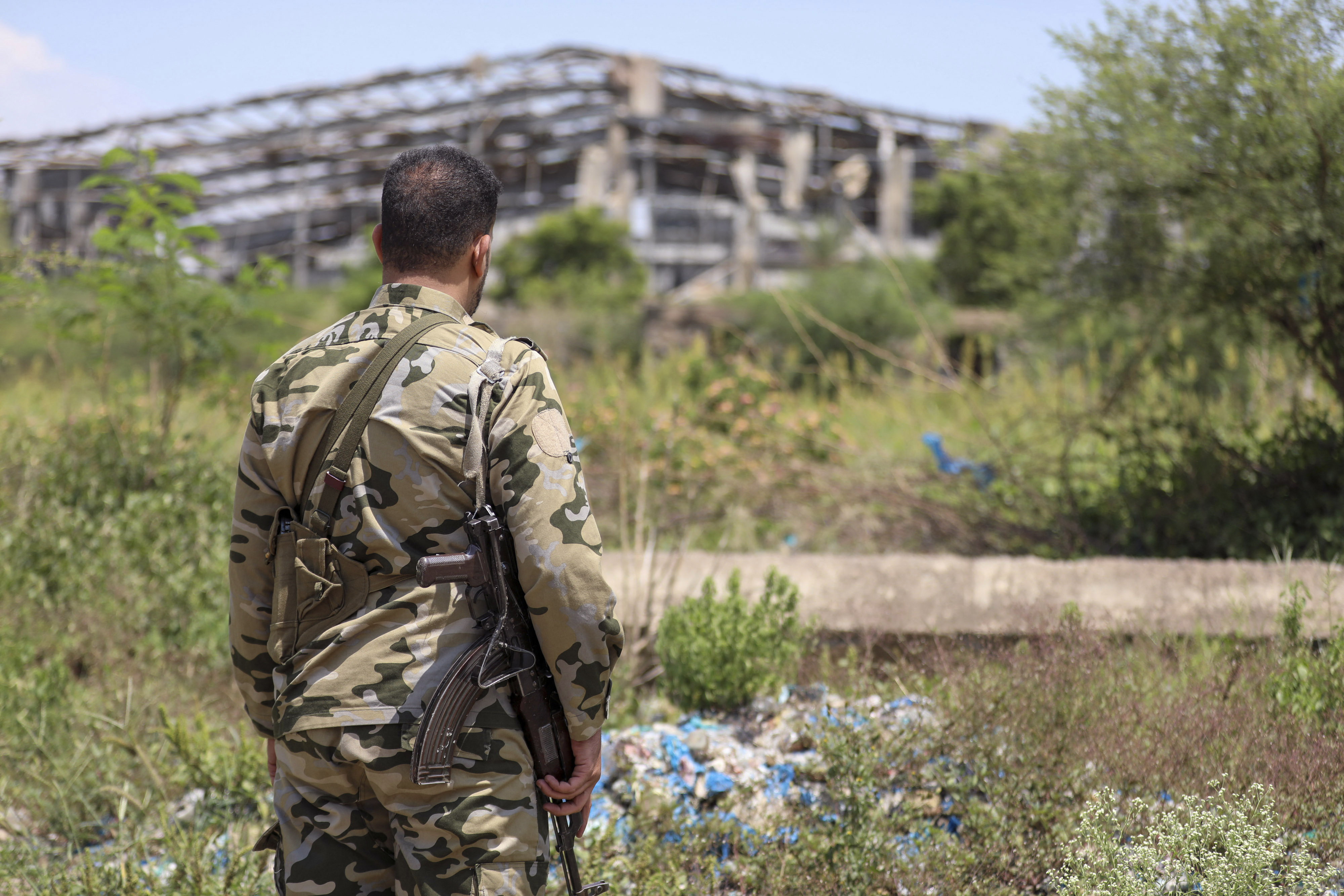
Can Yemen retake territory seized by the Ansar Allah Houthis?

Yemen’s internationally recognised government has said that its forces have retaken the strategic port city of Mocha and key positions near the Bab al-Mandeb strait as they pursue a major counteroffensive against the Houthis.
The Saudi-backed government’s military said on Monday that a “strategic offensive” has also been launched on Yemen’s capital, Sanaa, which the Houthis have held since 2014.
Recommended Stories
list of 4 items- list 1 of 4Saudi-led coalition dismisses ‘misleading’ Houthi claim of Riyadh attack
- list 2 of 4Inside the ‘kill box’: The Yemenis who stayed behind in Houthi-held Mocha
- list 3 of 4Yemen’s leader announces military operation to retake Houthi-held territory
- list 4 of 4Why is fighting intensifying in Yemen’s Taiz governorate?
The Houthis denied that Mocha had fallen.
Al Jazeera could not independently verify the battlefield claims.
In a post on X, the Yemeni government’s military said it took control of Mocha after “fierce fighting with the Houthis” and that battles there resulted in several Houthi casualties.
The Saudi-led military coalition backing the government also said on Monday that it had begun an air campaign against the Houthis.
The coalition’s spokesman, Major-General Turki al-Maliki, said 100 fighter jets were supporting Yemeni government forces and that the coalition had secured “air protection” over Bab al-Mandeb. Hundreds of Houthi targets were destroyed, he added.
Houthis dismiss response
Earlier on Monday, Yemeni government forces said they had reclaimed control of the Taiz governorate’s Dhubab district and key positions near the Bab al-Mandeb strait, as they seek to oust the Iran-aligned Houthis from control of the strategic waterway – a key route for global energy supplies.
The government-aligned Saba news agency reported that “forces from the Homeland Shield Forces and the Giants Brigades” were involved in the fighting in Dhubab.
“During the operation, they advanced and seized important positions – cutting off supply lines and roads leading to Bab al-Mandeb,” an unnamed army source told Saba.
Government forces are “continuing to comb and secure the liberated areas and cut off supply routes to the Houthi terrorist militia”, Saba reported.
The Houthis have dismissed the claims, with the group’s deputy governor of Taiz, Fuad Sinan, issuing a video statement from Mocha city on Monday evening.
“We are currently roaming around in the streets of Mocha city… negating any reports in the media about the occupation of Mocha city,” Sinan said in the video statement shared by Houthi officials on social media.
Al Jazeera’s Yousef Mawry, reporting from Sanaa, said that amid the conflicting claims, “what we do know for sure is that intense fighting is currently occurring in the south of Bab al-Mandeb, and also near the city of Taiz”.
He added, “We have to wait and see how the news is going to unfold in the coming hours so we can confirm 100 percent who’s in control.”
The Houthis have also claimed an attack on the King Khalid International airport in Riyadh and the Aramco refinery in coastal Rabigh. The group also said it hit a series of sites, including an airport, an airbase and other critical locations.
There was no confirmation from Riyadh on the Houthi claim.
‘Turning point’
The fighting is the latest turn in a conflict that has widened amid the United States and Israel’s war on Iran and Tehran’s closure of the Strait of Hormuz. The Houthis relaunched hostilities against the Saudi-backed government and, in a rapid offensive in mid-September, they seized Mocha as well as islands and territory around Bab al-Mandeb.
The advance choked off a second major oil passageway.
Since then, anti-Houthi forces have largely stabilised the front lines.
On Sunday, Rashad al-Alimi, the chairman of Yemen’s Presidential Leadership Council, announced the start of operations to retake all remaining Houthi-held territory.
Hisham al-Omeisy, a senior Yemen researcher at the European Institute of Peace, told Al Jazeera that a lot of observers were focused on the Red Sea “because that’s what basically triggers the attention of the international community because of the maritime routes”.
But, he said, “a turning point would be for the Yemeni government to take territories in the heartland, in the centre of the country; places like Taiz, places like al-Bayda, places like Ibb.”
The claims over Mocha on Monday came as defence and foreign ministers from Turkiye, Pakistan and Saudi Arabia met in Riyadh and agreed to activate “deterrence measures” under a mutual defence pact and rapidly deploy forces to Saudi Arabia to counter attacks by Yemen’s Houthis.
“The committee agreed to activate collective deterrence measures, within the framework of the Alliance, in response to the attacks and all those responsible for them,” Khalid bin Salman, Saudi Arabia’s defence minister, said in a social media post.
He said the alliance had “reaffirmed the solidarity and unity of our countries, in confronting the heinous attacks against the Kingdom, and holy sites”.
